Moving shipsShips provide two things, travel through Voidspace and air. ... More through space is a delicate and difficult task. But somehow spacers get it done every day. Here are the things you need to know about ship movement.
Ship Rating
Ship Rating (SR) is the basis for all movement done by a vessel. It is determined by the Navigator’s Level and the type of helm they are using.
Speed Ratings using Major and Minor Helms
| Navigator Level | Minor Helm | Major Helm |
| 1 | 2 | 4 |
| 2 | 2 | 4 |
| 3 | 3 | 5 |
| 4 | 3 | 5 |
| 5 | 3 | 5 |
| 6 | 4 | 6 |
| 7 | 4 | 6 |
| 8 | 5 | 7 |
Shipboard Skills
When traveling through space, at any speed, the crew needs to work the ship to keep things in working order. These are the skills used aboard the ship, and how they are used. Shipboard Skill Challenges use only the skills listed below.
| Skills | Uses |
| Acrobatics, Athletics, Climb, Pilot (Space) | Set sails and handle rigging. |
| Command, Strategy | Coordinate and direct the crew. |
| Navigate | Use star charts, books, and other instruments to guide the ship. |
| Spot | Watch for debris, hazards, and changes in the solar currents and winds. |
| Fine Manipulation, Repair | Maintain the ship and repair damaged equipment. |
Three Types of Ship Speed
ShipsShips provide two things, travel through Voidspace and air. ... More travel using three different movement modes. Tactical Speed is used during combat and close maneuvers. Void Speed is used to travel through normal space when Waygates are unavailable or a destination lies within the same region of space. Folding Space allows a Navigator to traverse the In-Between, crossing vast distances to emerge near a known Waygate.
Tactical Speed
Tactical Speed is equal to the ship’s Ship Rating (SR) plus one-half its Maneuverability Bonus (MB), rounded down. A ship can move one hex or turn one facing per Tactical Speed point. If the ship has a positive Maneuverability Bonus, the ship gains that many Free Turns.
Pushing the ship
Each round, during combat or a chase, heroes who are not operating the helm or manning weapons may work together to push the ship beyond its normal Tactical Speed. The crew chooses one Shipboard Skill and one hero to lead the effort. Make a cooperative skill roll using that skill and consult the table below.
| D100 Result | Effect |
| Critical | +2 Tactical Speed, +1 Free Turn |
| Special | +2 Tactical Speed |
| Success | +1 Tactical Speed |
| Failure | No Effect |
| Fumble | -1 Tactical Speed |
For NPC shipsShips provide two things, travel through Voidspace and air. ... More, roll 1d100 vs the crew modifier and compare to the chart above.
Free Turns
A ship may make a number of free 60° facing turns each round equal to its Free Turns rating. A ship’s Free Turns are determined by its Maneuverability ClassManeuverability Class - the base agility of a ship. More, though some Talents, upgrades, or special abilities may increase this number. Free Turns do not cost Tactical Speed, but still count toward the ship’s maximum turns per hex.
Void Speed
While Folding Space is the fastest way to travel between known regions of the galaxy, there are millions of star systems that lie beyond the Waygate network. ShipsShips provide two things, travel through Voidspace and air. ... More can travel through normal space using Void Speed, allowing them to explore uncharted systems, patrol local space, or reach destinations where no Waygate exists.
A ship’s Void Speed is based on its Sphip Rating (SR). A ship travels 5 parsecs per day for each point of SR.
| SR | Parsecs per Day | 1 Fold | Across the Galaxy |
| 1 | 5 | 200 days | 11 years |
| 2 | 10 | 100 days | 5.5 years |
| 3 | 15 | 67 days | 3.7 years |
| 4 | 20 | 50 days | 2.7 years |
| 5 | 25 | 40 days | 2.2 years |
| 6 | 30 | 33 days | 1.8 years |
Shipboard Skill Challenge
During travel, the crew will use Shipboard Skills to aid in the voyage. This is handled as a standard Skill challenge, but only using Shipboard Skills. If 50% or more of the skills are successful, the ship has no problems with traveling. If over half the skill checks fail, the ship will run into some unseen complication. Below is a quick chart for issues that could arise, but do not limit yourself to this chart; invent some of your own.
| D100 | Complication |
| 1-30 | Random Space Encounter |
| 31-55 | Space debris hit the ship, causing 2d10 hull damage. |
| 56-80 | Sails break and need repair, plasma battery charging slowed. |
| 81-96 | Rigging breaks and needs repair, reducing Tactical Speed by -1 until repaired. |
| 97-100 | Major mishap. The StoryGuide chooses or rolls twice. |
These skill challenges can happen as often as the SG likes, though it is best not to bog the game down with these challenges.
Folding Space
Folding Space is an ancient art the EldarEldar were the first race in the stars, the first to decode ... More learned from the derelict shipsShips provide two things, travel through Voidspace and air. ... More of the AncientsLittle is known about the race that came first. They built t... More. To initiate a fold, a Navigator must be bonded to a ship through votaraVotara is the extract of a void whale which allows for space... More, be able to channel mana, know the rune of the destination Waygate, and have sufficient Navigator level to complete the journey.
ShipsShips provide two things, travel through Voidspace and air. ... More can only fold to a known Waygate, magical constructs created by the First Travelers that serve as navigation beacons. A ship does not need to be at a Waygate to begin a fold, but it must have a Waygate as its destination.
A ship cannot begin a fold if a large body of matter is within 12,500 yards (7 miles). Planets, moons, asteroids, and other massive objects interfere with the fold and prevent it from forming.
During a fold, the ship travels through the In-Between, a plane that exists alongside the Prime Plane. Time flows differently there, and although the duration varies, a single fold takes an average of two days. In a single jump, a Navigator may travel a number of folds equal to their Navigator level.
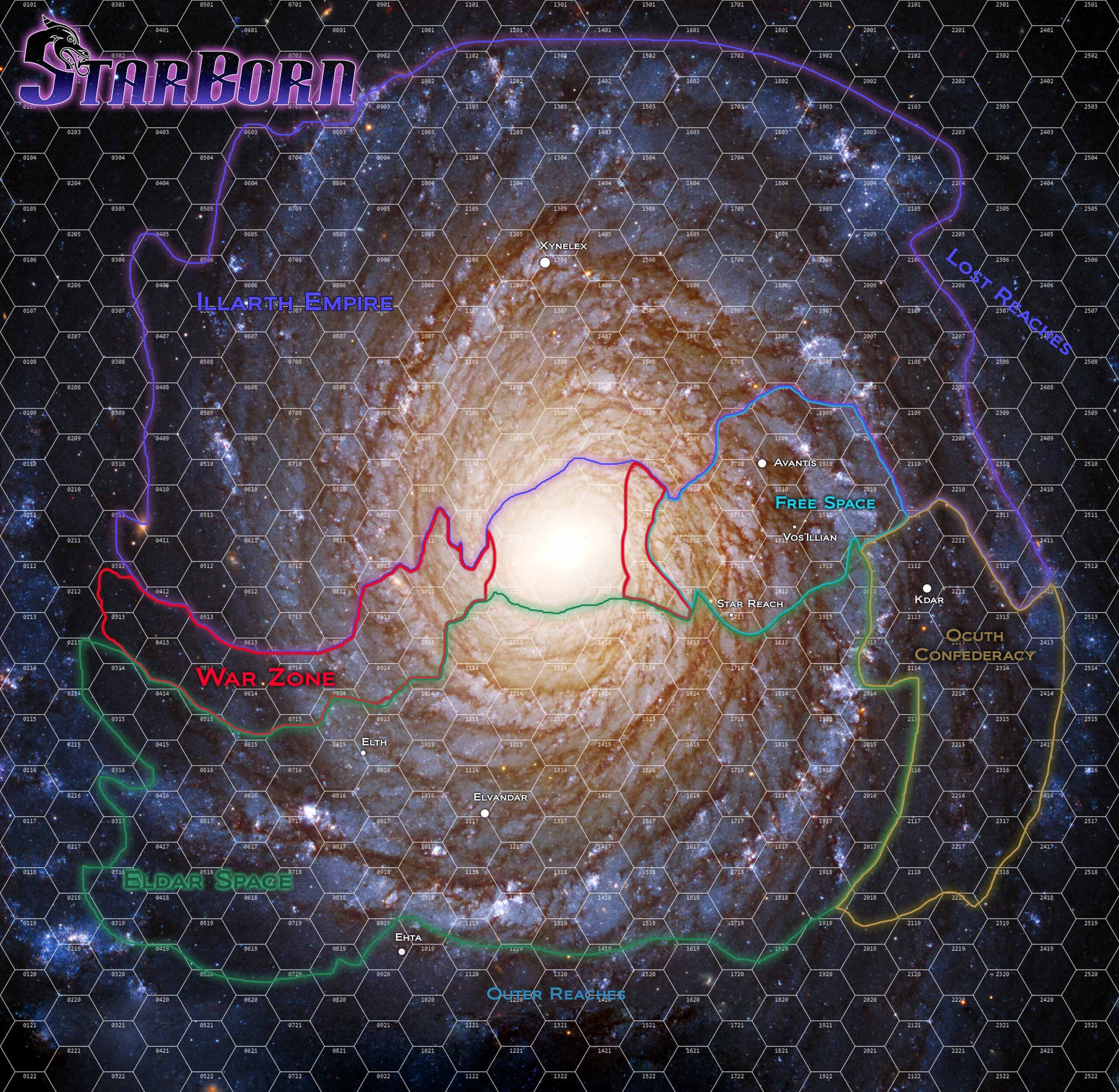
Map of the Galaxy
The Galaxy is approximately 20 folds across, with each fold being 1,000 parsecs.